The Quest for Optimal Light Distribution
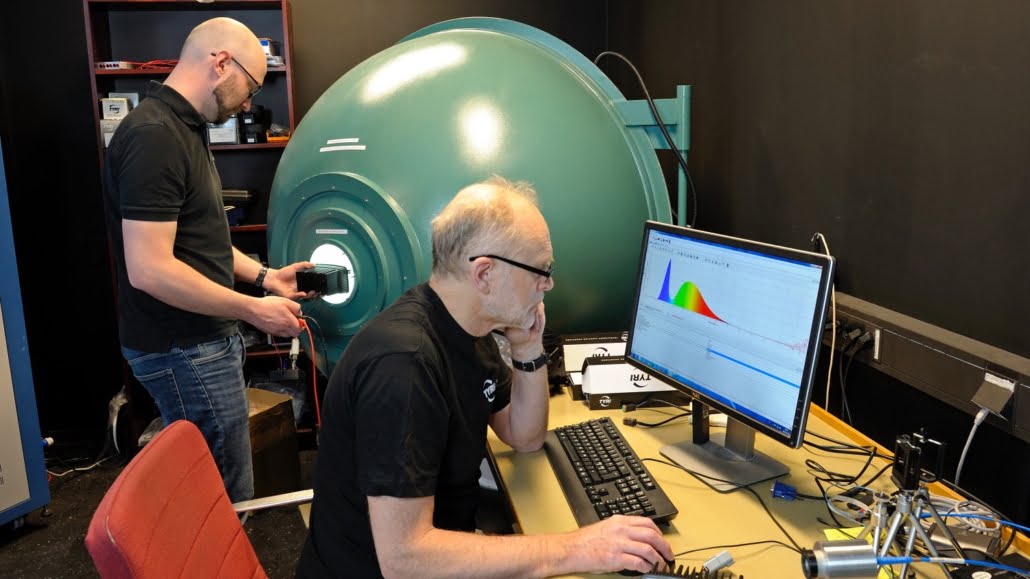
Optical engineering is a challenging profession. This is particularly true when optical solutions must be adapted to design preferences while retaining optimal light distribution. Per-Arne Torstensson is a Senior Optical Engineer at TYRI whose workday consists of integrating lens systems and technologies in lights with a specific visual design. He tells us a bit more about important things to consider when attempting to create optimal light distribution.
Per-Arne Torstensson has worked with optics for over 30 years, the last three of which have been at TYRI. “The reason I applied to work at TYRI was because they utilised LightTools, one of the most sophisticated software tools for optical design. This aroused my curiosity immediately and I felt it would be an exciting challenge. At TYRI I am able to further develop my optics expertise in lighting, and I am also able to learn how a light and its technology can be integrated in a specific visual design,” says Per-Arne.
OPTICAL ENGINEERING
A large part of Per-Arne’s work involves creating optimal light distribution around a heavy vehicle, which often has many different lights mounted that must be combined in the right way for the best possible illumination. Furthermore, the lights must also satisfy customer design preferences without compromising the quality of light distribution. “A forestry industry harvester usually has 25 to 30 lights, which frequently have different properties and different light distribution. The lights must have different properties but still work together to achieve optimal light distribution around the vehicle. It’s a fairly complex task getting this to work, and it is this knowledge that we at TYRI want to share with our customers. The correct lighting on a heavy vehicle is imperative for both safety and productivity,” says Per-Arne.
LENS DESIGN
Design within lighting has become increasingly important over the years, and vehicle lights are today a hallmark of many brands. TYRI works regularly with design development, and gladly develops new lights based on customer design preferences. Sometimes, however, a design specification from a customer has already been fully decided, which makes it difficult to achieve an optimal solution for the optical system. It is Per-Arne’s job to tackle this challenge and try to find a lens design able to fit the criteria.
Complicated designs sometimes require more than one lens, which together direct uniform and powerful light around the heavy vehicle. The lenses are produced by injection moulding with different plastic materials such as polycarbonate. The calculated shape of the lens must be preserved throughout production, but since plastic shrinks when it cools after injection moulding, irregularities in the shape sometimes crop up which significantly change the properties of the lens. These irregularities can often be compensated for in the calculations prior to moulding, but, when working on multiple lenses, the irregularities can accumulate and complicate the work.
LIGHT GLARE
Another important aspect of working with optics is to try to create light distribution that produces minimal glare. One of our goals is to start using cameras as sensors in INTELLilight lights, since this would provide more information about oncoming light and manage dimming more efficiently.”
LIGHT DISTRIBUTION AND LUMEN
An LED module distributes light in different directions, and the lens system must then direct the light to achieve the desired light distribution. It’s important to remember that the lumen total cannot describe good light distribution alone. Light distribution of 2,500 lumen can be much better than 4,000 lumen, since the latter can diffuse and have a greater risk of glare.
“What best describes a light’s properties is its intensity distribution, in other words, how the light is distributed at different angles, not the LED light’s maximum lumen. Many customers make the mistake of asking for the highest lumen total, but that does not necessarily provide the best light distribution. This can be compared to judging the performance of a car by only getting information about its horsepower, which says nothing about how fast the car accelerates or its top speed. Good light distribution is far more complicated than a high lumen total,” says Per-Arne.
Moreover, different companies and suppliers measure lumen based on different factors. Manufacturers in China, for example, frequently specify the theoretical lumen instead of the effective lumen retained after the light has passed through the lens system. In a best case scenario, approximately 75-80 percent of the LED light’s theoretical lumen can be collected by a lens. In inadequate optical solutions, not even half of the light’s theoretical lumen may be attainable.